
Last updated September 23, 2026
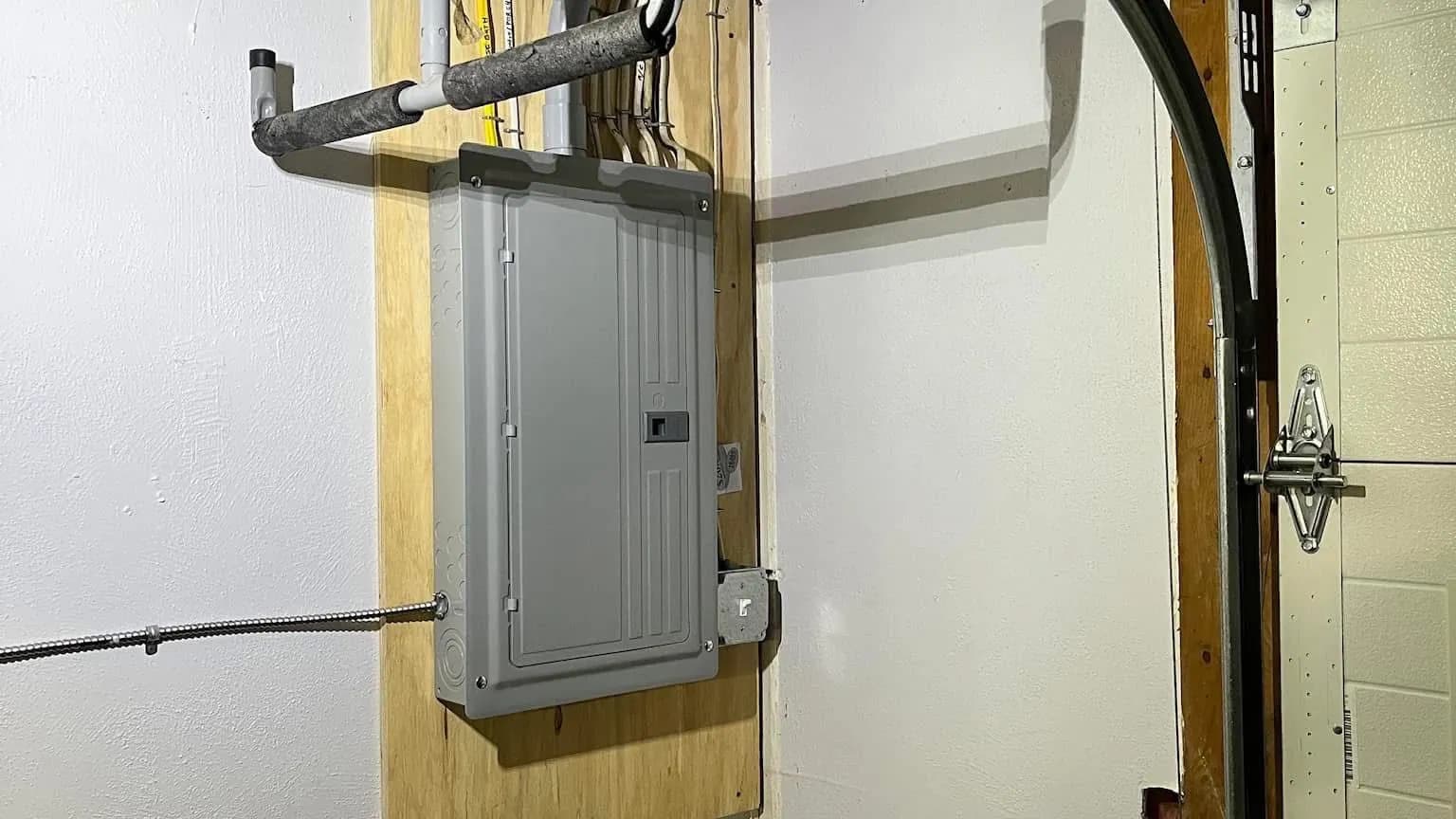
Your panel qualifies for a Level 2 EV charger if it has enough spare capacity to carry the charger as a continuous load and two open slots for a 240-volt breaker. A rough rule of thumb is that a 200-amp panel with a couple of empty double-pole slots usually has room for a Level 2 charger, while a 100-amp panel may or may not, depending on what else the home runs. But the only real answer comes from a load calculation on your actual home, and that is the first thing we do before any wire is pulled. If your service is close to full, we tell you up front and lay out your options honestly, for homeowners from Salem and Londonderry to Plaistow and Kingston.
What is a load calculation, in plain English?
It is the math that adds up how much electricity your home already uses and checks whether there is headroom left for something new. The National Electrical Code, in Article 220, lays out exactly how to do this so it is done the same way every time, not by guesswork. It accounts for your general lighting and receptacles, your heating and cooling, your range, your water heater, and any other large loads, then compares that total against the size of your service. Whatever is left over is the room you have for a charger. A licensed electrician does this the code way, which is also the way an inspector will check it.
Why is an EV charger treated differently from a normal appliance?
Because it runs for hours at a stretch. The code calls that a continuous load, any load expected to run for three hours or more, and EV charging is specifically defined as continuous in NEC Article 625. Continuous loads have to be sized to 125 percent of their rated current, to keep the wire and breaker from running hot for hours on end. That is why a 40-amp charger needs a 50-amp circuit, and a 48-amp charger needs a 60-amp circuit. It also means a charger takes up more of your panel's capacity than its label alone suggests, which is the detail that trips up a lot of do-it-yourself estimates.
How much of my panel's capacity does a charger actually use?
More than people expect. Under the code's load rules, an EV charging circuit is counted at that 125 percent continuous figure, so a 48-amp charger is figured as a 60-amp load on your service. On a home that already runs a heat pump, an electric range, and an electric water heater, that can be the load that pushes a 100-amp or 150-amp service over the line. We run the numbers on your specific panel so you know for certain, rather than finding out after the charger is on the wall and the main breaker starts tripping on a cold night.
Does the charger need its own circuit and open slots?
Yes. A Level 2 charger gets a dedicated 240-volt branch circuit that feeds nothing else, no shared garage outlet and no lighting on the same wire. That is both a code expectation and what keeps your charging fast and trouble-free. It is also why the panel needs two adjacent open slots for a double-pole breaker. A panel that is physically full, with no open spaces, may still have electrical capacity but no room to land the breaker, which is a separate problem we check for during the same visit.
Can my 100-amp service handle a Level 2 charger?
Sometimes, and sometimes not, which is exactly why the load calculation matters. A 100-amp home on gas heat with modest loads may have room for a right-sized charger. A 100-amp home already running electric heat and a full set of electric appliances usually does not, at least not at full charging speed. This comes up often in older homes around Derry and Plaistow that were built for a much lighter electrical life than a modern EV household lives. We give you a straight yes or no for your home, in plain language, before you spend a dime on equipment.
What if my panel does not have room?
You have more options than a full panel swap, and we walk you through the honest trade-offs. Sometimes the answer is a service or panel upgrade, which is the right move if you are adding other loads anyway, like a heat pump or a hot tub. Sometimes a lower-amperage charger, dialed to what your service can carry, gets you a full overnight charge without touching the panel, because most drivers add far less range per night than a 48-amp unit could deliver. And in some homes a load-management device that shares capacity between the charger and other big loads avoids an upgrade entirely. We recommend the one that fits your home and your car, not the most expensive one.
Does adding a charger change my permit or inspection?
It is permitted, inspected work either way, and the state you are in sets the rules. In New Hampshire a charger circuit follows the state-adopted 2023 National Electrical Code and is inspected locally. In Massachusetts towns like Andover and Methuen it follows 527 CMR 12.00, the Massachusetts Electrical Code, and the permit is filed with the local Inspector of Wires. A panel upgrade, if you need one, is permitted and inspected the same way, and it is coordinated with your utility. We handle the permit under the correct license, NH 13087 or MA 20906-EL-A, so the charger and any panel work are on the record and pass inspection.
What does a panel upgrade for an EV charger actually involve?
If the load calculation says your service is too small, the fix is usually a service or panel upgrade, and it is a bigger job than just adding a breaker. Depending on what your home has today, it can mean a larger main breaker and panel, often a move from a 100-amp service up to 200 amps, and sometimes a new meter base, fresh service-entrance cable, and updated grounding and bonding to current code, all coordinated with your utility for the disconnect and reconnect. The upside is that once it is done you have headroom not just for the charger but for the next projects too, a heat pump, a hot tub, or a generator. This is why we lay out the honest trade-off: if you are adding several electric loads anyway, upgrading once is smarter than paying to squeeze in each one separately. If the charger is all you need and a smaller charger or load management fits, we will tell you that instead.
How many amps does a typical Level 2 charger draw?
Most home Level 2 chargers are set for 32, 40, or 48 amps of charging, which under the code's continuous-load rule occupy a 40, 50, or 60-amp circuit respectively. A 48-amp charger, the fastest common setting, is the one that eats the most panel capacity, counted as a 60-amp continuous load. Many chargers are adjustable, so if your service is tight, dialing the charger to 32 amps still fills the car overnight for most drivers while using far less of your panel. That flexibility is often the key to fitting a charger into an older home without a full upgrade, and it is one of the first things we check when the load calculation comes back close.
Can load management let me add a charger without a panel upgrade?
Often, yes, and it is one of the most useful tools for a full or near-full panel. An electric-vehicle energy-management system, or a smart circuit-sharing device, watches your home's total draw and throttles or pauses the charger when the rest of the house is using a lot, so the charger only pulls its full current when there is room. The National Electrical Code recognizes these systems, and they can let a home add EV charging on a service that a straight load calculation says is too tight, because the charger is managed rather than counted at its full continuous value. We will tell you honestly when load management is the smart, lower-cost path and when your home genuinely needs the panel upgrade instead.
How do I find out if my panel qualifies?
Have us do the load calculation. We look at your panel, measure your real usage, check your open slots, and tell you whether your charger drops right in or whether the service needs a look first. Homeowners in Londonderry, Salem, and Plaistow have started exactly here, and the estimate is free.
Have a question this did not cover? Call or text us at (603) 401-7359 and we will give you a straight answer.
Sources
- NFPA - Understanding the National Electrical Code (Article 220 load calculation, Article 625 EV)
- U.S. EPA - Getting Started with Home EV Charging
- ENERGY STAR - Make Your Home Electric Ready (panel capacity, dedicated circuits)
- U.S. Department of Energy (BSESC) - Home Electrification and Electric Panel Upgrades
- Tesla - Gen 3 Wall Connector Installation Guide (circuit sizing example)
- NH Division of Fire Safety - Fire Codes Adopted for NH (NEC 2023)
- Mass.gov - 527 CMR 12.00 Massachusetts Electrical Code (amendments)