
Last updated September 27, 2026
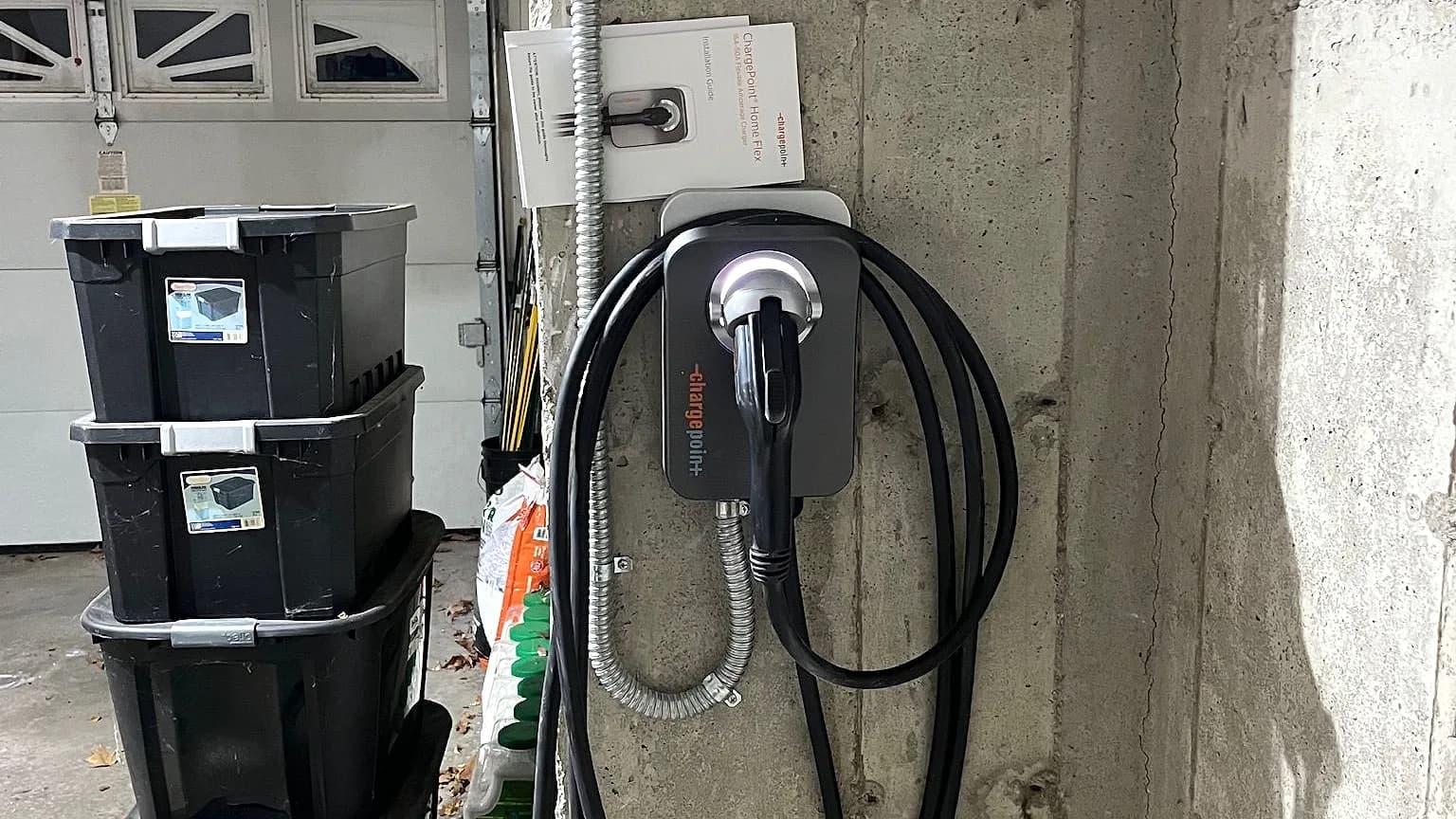
A home Level 2 EV charger needs its own dedicated 240-volt circuit and enough panel capacity to carry it. Lembo Electric confirms your service can handle the load with a real calculation, runs the right circuit from your panel, and mounts the charger so you plug in overnight and wake up full. The install is clean, to code, and sized correctly the first time. We do this across Rockingham County and down into the Merrimack Valley, under NH Master Electrician License 13087 in New Hampshire and MA license 20906-EL-A in Massachusetts, and the estimate is free.
Can my panel handle an EV charger?
That is the first question, and it is answered with a load calculation, not a guess. An EV charger is what the code calls a continuous load, because it runs for three hours or more at a stretch, so under NEC Article 625 the circuit is sized to 125 percent of the charger's rated current. A 40-amp charger lands on a 50-amp circuit, and a 48-amp charger needs a 60-amp circuit. That also means a charger takes up more of your panel's capacity than its label alone suggests. If your service already runs close to full, we tell you before any wire is pulled and lay out your options honestly, which sometimes includes a panel upgrade and sometimes does not.
Does the charger need its own dedicated circuit?
Yes. Each charger gets a dedicated branch circuit that feeds nothing else, no shared garage outlet, no lighting on the same wire. That is a code requirement, and it is also what keeps your charging fast and trouble-free. It is why your panel needs two adjacent open slots for a double-pole breaker, and why a panel that is already full may need attention before a charger goes in. A dedicated circuit is not an upsell, it is the baseline for doing the job right.
What is the difference between Level 1 and Level 2 charging?
Level 1 is the cord that plugs into an ordinary 120-volt outlet, and it adds only a few miles of range per hour, which is fine for a plug-in hybrid or a very light commute. Level 2 uses a dedicated 240-volt circuit and charges several times faster, enough to fill most electric cars overnight. The U.S. Environmental Protection Agency notes that Level 2 charging is what most homeowners install for daily driving, because it reliably refills a car overnight on off-peak hours. For most people who drive an EV every day around Salem, Windham, or Methuen, Level 2 is the setup that actually fits their life, and it is what we install most often.
How long does an EV charger install take?
A straightforward install where the panel has capacity and the run to the garage is short is often a same-day job. A longer wire run, a finished wall to fish through, an outdoor mount, or a panel that needs attention first adds time. We give you the real timeline with the estimate so there are no surprises, and we route the circuit cleanly rather than taking the ugly shortcut. The goal is an install that looks like it belongs there and works for the life of the car.
Can I plug in a Level 2 charger instead of hardwiring it?
Some Level 2 chargers are made to plug into a 240-volt outlet, and some are hardwired directly to the circuit. A plug-in unit can be convenient, but the outlet itself has to be installed correctly and, under the current code, GFCI-protected, and the fastest chargers are hardwired because no standard receptacle is rated for continuous 48-amp operation. We will tell you which approach fits your charger and your garage, and either way the circuit behind it has to be sized and installed to code. If you want the maximum charging speed, plan on hardwiring.
Are there permit and inspection differences between NH and MA?
Yes, and it is worth knowing which state you are in. An EV charger circuit is permitted electrical work in both. In New Hampshire the work follows the state-adopted 2023 National Electrical Code and is inspected by the local wiring inspector, or through the state in towns without one. In Massachusetts it follows 527 CMR 12.00, the Massachusetts Electrical Code, and the permit is filed with the local Inspector of Wires, who has to inspect before the work is covered. Because we are licensed in both, a charger in Andover or Haverhill is pulled and inspected under Massachusetts rules and one in Atkinson or Kingston under New Hampshire rules, with the correct license on the permit.
Is there any tax credit or rebate for a home charger?
There was a federal credit, and it has ended. The federal Alternative Fuel Vehicle Refueling Property Credit under Internal Revenue Code Section 30C offered 30 percent of the cost of a home charger, up to 1,000 dollars per port, but only for property installed in an eligible census tract, and that credit ended for chargers placed in service after June 30, 2026. Incentives change, so confirm what is currently available with your utility and your tax preparer before you count on any of it. We do the electrical work to code so the install supports whatever program you qualify for, and we will point you at the right pages, but we are not a tax service and will never promise you a credit amount.
How much does a home EV charger install cost?
As general figures to set expectations, national cost guides put a typical Level 2 charger install in the range of about 500 to 1,500 dollars for the labor and materials, separate from the charger unit itself, with a short run to a panel that has capacity at the low end and a long run, an outdoor mount, or a panel that needs work at the high end. If your service needs a panel upgrade to make room, that is a separate job with its own price. Those are national ranges, not your number. We come out, look at your panel and the run to where you park, and give you a written estimate for your actual home, and the estimate is free.
How fast will a Level 2 charger fill my car?
Fast enough to wake up full most nights. A Level 2 charger typically adds somewhere around 25 to 40 miles of range per hour, depending on your car and the amperage of the circuit, so an overnight charge easily covers a normal day of driving and then some. A higher-amperage charger on a bigger circuit charges faster, but for most drivers around Windham or Londonderry the limiting factor is not speed, it is simply plugging in at night. We size the circuit for the charging speed you actually need, which sometimes means the full amperage and sometimes means a right-sized circuit that still fills the car by morning without a panel upgrade.
Should the charger go inside the garage or outside?
Wherever it reaches your car cleanly, and both work when the install is done right. An indoor garage mount keeps the unit out of the weather and is the simplest run in many homes. An outdoor mount is common where people park in a driveway, and a good Level 2 charger is rated for it as long as it is mounted and sealed properly, which matters through a New Hampshire winter of snow and road salt. We route the circuit so the cable reaches without stretching, mount the unit at an easy height, and weatherproof an outdoor install so ice and moisture are never a problem.
Which chargers do you install?
Level 2 chargers from all the common brands, hardwired or plug-in, for whatever electric car or plug-in hybrid you drive. If you have not bought one yet, we will point you at a unit that fits your car and your panel rather than the most expensive option, and set it up for the fastest safe charge your service can support. We install and inspect EV chargers throughout Southern New Hampshire, from Salem and Londonderry to Plaistow and Kingston, and across the Merrimack Valley in Methuen, Haverhill, and Andover, each job pulled under the correct state license so it is on the record and passes inspection. Whatever you drive and whatever panel you have, the goal is the same: a clean, code-correct install sized right the first time, and a free honest estimate before any work begins.
Have a question this did not cover? Call or text us at (603) 401-7359 and we will give you a straight answer.
Sources
- NFPA - Understanding the National Electrical Code (Article 625, EV charging, continuous load, 125% sizing)
- U.S. EPA - Getting Started with Home EV Charging
- Tesla - Gen 3 Wall Connector Installation Guide (hardwired, 60A breaker, 48A output)
- IRS - Alternative Fuel Vehicle Refueling Property Credit (Section 30C) for Individuals
- ENERGY STAR - Make Your Home Electric Ready (panel capacity, dedicated circuits)
- NH Division of Fire Safety - Fire Codes Adopted for NH (NEC 2023)
- Mass.gov - 527 CMR 12.00 Massachusetts Electrical Code (amendments)