
Last updated September 27, 2026
To charge at full speed, a Level 2 home charger needs its own 240-volt circuit sized to 125 percent of its output, and the fastest 48-amp units have to be hardwired on a 60-amp circuit with the correct copper wire. Lembo Electric confirms your panel can carry that load with a real calculation, runs the dedicated circuit, and sets the charger to match the breaker, so you get the fastest safe charge your home can support, whatever you drive. We install Level 2 chargers across Southern NH and the Merrimack Valley, to code, under the correct state license, and the estimate is free.
Why does the breaker size decide the charge speed?
Because an EV charger is a continuous load, and NEC Article 625 sizes the circuit to 125 percent of the charger's current. That is why 48 amps of charging lands on a 60-amp breaker rather than a 50. Manufacturer installation guides confirm it: for maximum output, a 48-amp charger goes on a standard double-pole 60-amp breaker and delivers up to 11.5 kW at 240 volts. Most adjustable chargers are set to match the breaker they are on, so on a 60-amp circuit the unit runs the full 48 amps, and on a 40-amp breaker it is dialed down to 32. The breaker is the ceiling, and the charger never exceeds it.
Why is the fastest install hardwired instead of plugged in?
Because no standard 240-volt receptacle is rated to carry a continuous 48-amp load, which is why 48-amp chargers are hardwired for their full output. A plug-in install on a NEMA 14-50 outlet tops out lower, at 40 amps of charging on a 50-amp circuit, and adds an outlet that itself has to be installed correctly and GFCI-protected. If you want the full 48 amps and the tidiest result, hardwiring is the way, and it is how we install most Level 2 chargers.
What wire and breaker does a 48-amp charger need?
A 60-amp double-pole breaker and copper wire sized for it. A typical manufacturer install guide calls for a minimum of 6 AWG copper with a 75-degree-rated breaker, or heavier 4 AWG copper with a 60-degree-rated breaker, and copper rather than aluminum at the charger's terminals. The exact wire depends on the run length, the breaker rating, and your charger's own instructions, which is part of why this is licensed work rather than a weekend project. We read the specifics of your install, the distance from the panel, the wall type, indoor or outdoor, and size the conductors correctly so the circuit runs cool at full load for years.
Will my service handle the full 48 amps?
That is the question we answer before we start, with a load calculation on your actual panel. Many homes can. Some are close to full and need a look at the service first, especially older homes in Derry or Plaistow still on a 100-amp or 150-amp service that already runs electric heat and a full set of appliances. Either way, you get a straight answer up front, not a surprise after the wire is in the wall. If your service is tight, we will tell you whether a dialed-down charging rate solves it or whether a panel upgrade is the honest fix.
Can two EV chargers share one circuit?
Often, yes, and it is a genuinely useful feature for a two-EV household. Many Level 2 chargers include a power-sharing feature that lets two or more units of the same model safely share a single branch circuit and automatically split the available power between the cars, so you can charge both without doubling the electrical work. Whether it fits depends on your panel's capacity, your charger model, and how much charging speed each car needs, so we run the numbers and tell you whether power sharing is the smart way to go for your home, or whether two separate circuits make more sense.
Where can the charger be mounted?
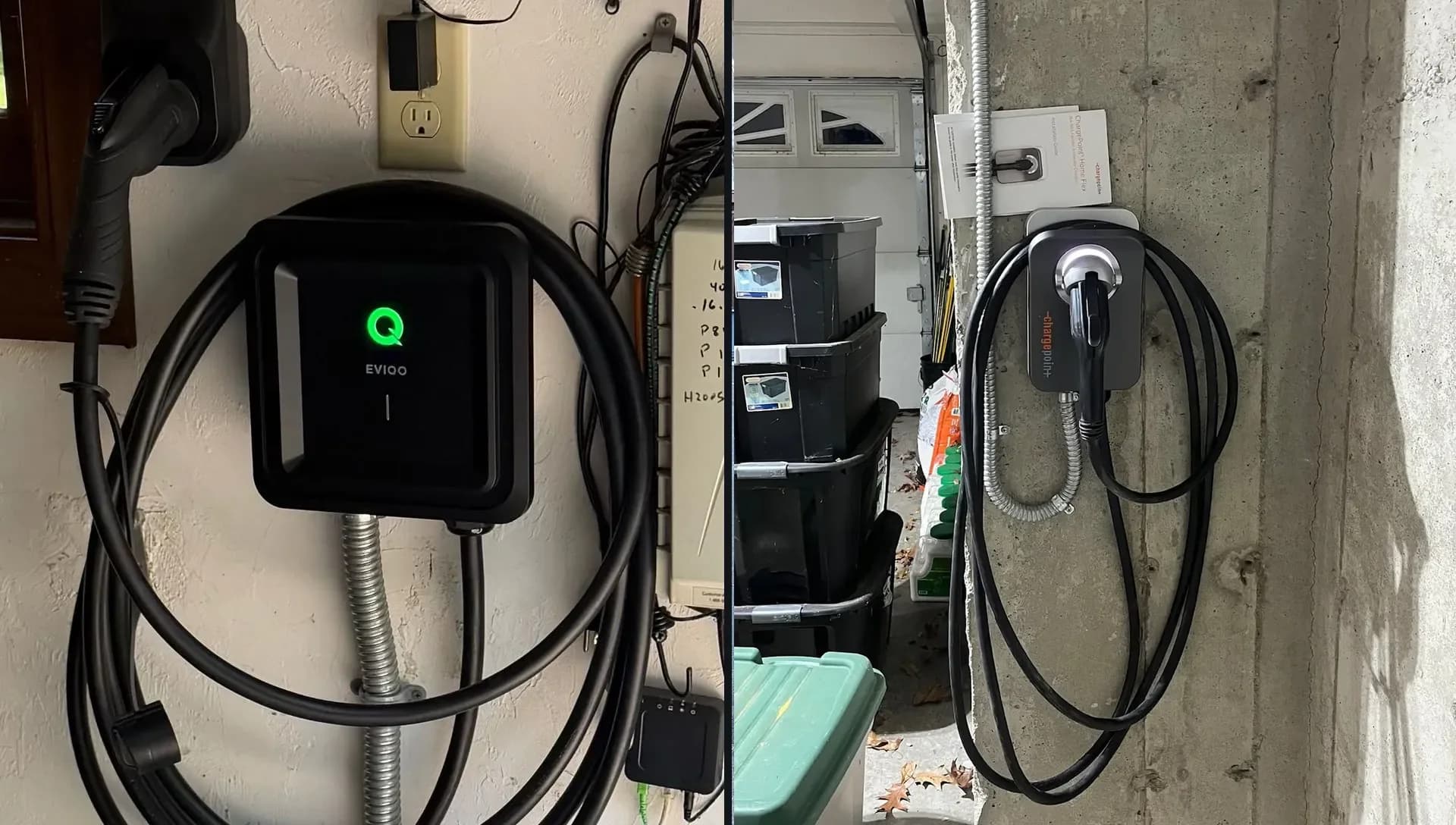
Inside a garage or outside on an exterior wall, wherever it reaches your car cleanly. Most quality Level 2 chargers are rated for outdoor installation when they are mounted and sealed correctly, which matters in a New Hampshire winter. We route the circuit so the run is tidy and the cable reaches without stretching, mount the unit at a height that is easy to use, and weatherproof an outdoor install properly so snow and ice are never a problem.
What happens to my charger in a power outage?
A standard Level 2 charger needs grid power to charge, so in an outage it simply waits until power returns. If keeping your car charged through outages matters to you, that is a conversation about backup power, a standby generator or a home battery, and how the charger fits into it. We can look at your whole setup, the panel, the charger, and any backup plans, and tell you honestly what is worth doing rather than selling you something you do not need.
What is the difference between a Level 2 charger and the portable cord that came with my car?
The portable cord that ships with most EVs is meant to plug into an outlet, and on a standard 120-volt household outlet it is only Level 1 charging, a few miles of range per hour. Some cords can plug into a 240-volt outlet with the right adapter and charge faster, but they still top out well below a dedicated Level 2 charger and depend on that outlet being installed and protected correctly. A wall-mounted Level 2 charger is the permanent home charger built for daily use at up to 48 amps, with a longer cable, a tidy wall mount, and, on many models, power sharing and scheduling the portable cord does not have. For a household that charges at home every night, the wall-mounted charger is the unit that actually fits the routine, and it frees the portable cord to stay in the trunk for travel. We install it so it does its full job rather than leaning on a portable cord and an outlet that was never meant for hours of continuous load.
How much range does a Level 2 charger add per hour?
At its full 48 amps, a Level 2 charger delivers about 11.5 kW, which works out to roughly 25 to 44 miles of range per hour depending on the vehicle. Your car's onboard charger also sets a limit, and some models accept less than 48 amps, so the charger only delivers what the car can take. Either way, most EVs charge from a typical daily state to full in a few overnight hours, and you almost never wait on the car. On a lower-amperage circuit the speed drops proportionally, so a 32-amp setup on a 40-amp breaker still fills most cars overnight for a normal commute. For a household in Salem or Atkinson that drives a normal daily distance, the full 48 amps is more than enough, and the real value is simply plugging in at home instead of stopping at a public charger.
Do I need Wi-Fi for the charger to work?
No, a smart Level 2 charger charges your car whether or not it is connected to Wi-Fi. What Wi-Fi adds is convenience: firmware updates, usage monitoring, scheduled charging, and on many models the setup for power sharing between multiple units. It is worth connecting during the install so the unit stays current and, if you ever add a second charger, power sharing is ready to configure. We set the unit up and, if your garage Wi-Fi reaches it, get it connected as part of a clean install.
What does a Level 2 charger install cost?
As general figures to set expectations, national cost guides put a typical hardwired Level 2 install in the range of about 500 to 1,500 dollars for labor and materials, separate from the charger itself, with the run length, the wall type, an indoor or outdoor mount, and whether your panel has capacity all moving the number. A home that needs a panel or service upgrade to free up capacity is a larger job with its own price. Those are national ranges, not a Lembo quote. We look at your panel and the run to where you park and give you a written estimate for your home, and it is free.
Which EVs work with a Level 2 charger?
Nearly all of them. Every mainstream electric car and plug-in hybrid sold in North America can charge on a Level 2 charger, including models from Ford, Chevrolet, Hyundai, Kia, Toyota, Nissan, Volkswagen, BMW, Rivian, and Tesla. Most use the J1772 plug, a growing number use the NACS plug the industry is moving to, chargers are sold with either one, and adapters bridge the two. We will help you pick a unit with the right plug for your car and the amperage your panel can support, rather than the priciest box, and if a second EV with a different plug is in your future, we will point you at a setup that covers both.
Have a question this did not cover? Call or text us at (603) 401-7359 and we will give you a straight answer.
Sources
- Tesla - Gen 3 Wall Connector Installation Guide (60A breaker, 48A output, 6AWG copper)
- Tesla - Universal Wall Connector, Circuit Breaker Rating / Maximum Output
- NFPA - Understanding the National Electrical Code (Article 625, continuous load, 125% sizing)
- U.S. EPA - Getting Started with Home EV Charging
- IRS - Alternative Fuel Vehicle Refueling Property Credit (Section 30C) for Individuals
- NH Division of Fire Safety - Fire Codes Adopted for NH (NEC 2023)