Last updated September 27, 2026
Sizing a standby generator comes down to one honest question: how much of your home do you want to keep running when the power goes out? An essential-circuits setup keeps the things that matter in a storm, the heat, the well pump, the refrigerator, and a few key circuits. A whole-house unit carries the entire home, including central air and the big kitchen loads. Our team walks your home, adds up the real running load plus the largest motor's startup surge, and sizes from that instead of selling you the biggest unit on the shelf. We do this on homes from Atkinson and Hampstead up through Derry and Londonderry, and the estimate is free.
Essential circuits or whole house, which do I need?
Most New Hampshire homes land in the middle, and that is fine. Generac's own guidance describes an essential-circuits approach that protects a refrigerator, lighting, the well pump, and a handful of critical outlets, and a whole-house approach that adds HVAC, kitchen appliances, and high-draw systems. The right call depends on how you live. If a multi-day outage mainly means you need heat, water, and food kept safe, essential circuits may be plenty. If you work from home, have medical equipment, run a home business, or simply want the house to feel normal in an outage, whole-house is worth pricing. There is no single right answer, only the one that fits your household.
How is the generator size actually calculated?
By math, not by square footage alone. The generator has to cover the total wattage of everything running at once, plus the extra surge a motor pulls the instant it starts. A well pump, a heat pump, or a central air compressor can draw two to three times its running wattage for a moment on startup, and the generator has to swallow that spike without stalling. This is why Generac points homeowners to a professional load analysis rather than a rule of thumb, and it is the same load-calculation discipline the National Electrical Code uses for sizing services. We do that analysis on your actual home, measuring what you run and what the biggest motors demand at startup, so the unit is neither undersized and tripping nor oversized and overpriced.
What size generator do most homes need?
As general figures to set expectations, Generac's sizing guidance puts many homes in the range of about 10 to 14 kW for essential circuits, and roughly 18 to 22 kW for whole-home comfort, with larger homes or heavy electric heating needing 24 kW or more. Those are starting points, not your number. A home with a heat pump, a well pump, and electric appliances demands more than a similar home on natural gas heat, and an all-electric home in Windham will need more than a smaller gas-heated ranch in Plaistow. We give you the size your home genuinely calls for after we see the load, so you are not paying for kilowatts you will never use.
Can a smart transfer switch let me buy a smaller unit?
Often, yes, and it can save you real money. A managed transfer switch, what Generac calls a load manager, watches the generator in real time and briefly pauses lower-priority loads if too much tries to start at once, for example if the air conditioner and the electric dryer kick on together. That load management lets a well-chosen mid-sized unit cover a home that would otherwise need a larger, pricier generator. It is one of the most useful tools for right-sizing, because it smooths out the startup peaks that would otherwise force you into a bigger unit. We will tell you honestly when load management is the smart way to right-size, and when your home really does need the larger generator.
What does a New Hampshire winter demand from a generator?
More than a summer outage does, because the stakes are higher when it is cold. A multi-day winter outage can mean a house that will not heat, frozen and burst pipes, and a dead sump pump letting a basement flood during a thaw. Those are the loads that belong at the top of your priority list here in Rockingham County: the heating system, the well pump, and the sump pump. Ice storms are the specific threat, because ice on the lines brings down power for days at a stretch, and the 2008 ice storm proved how long that can last in Southern New Hampshire. We size the unit so those critical loads never drop, then add the comfort loads your budget allows.
Why does the fuel and the transfer switch matter as much as the kilowatts?
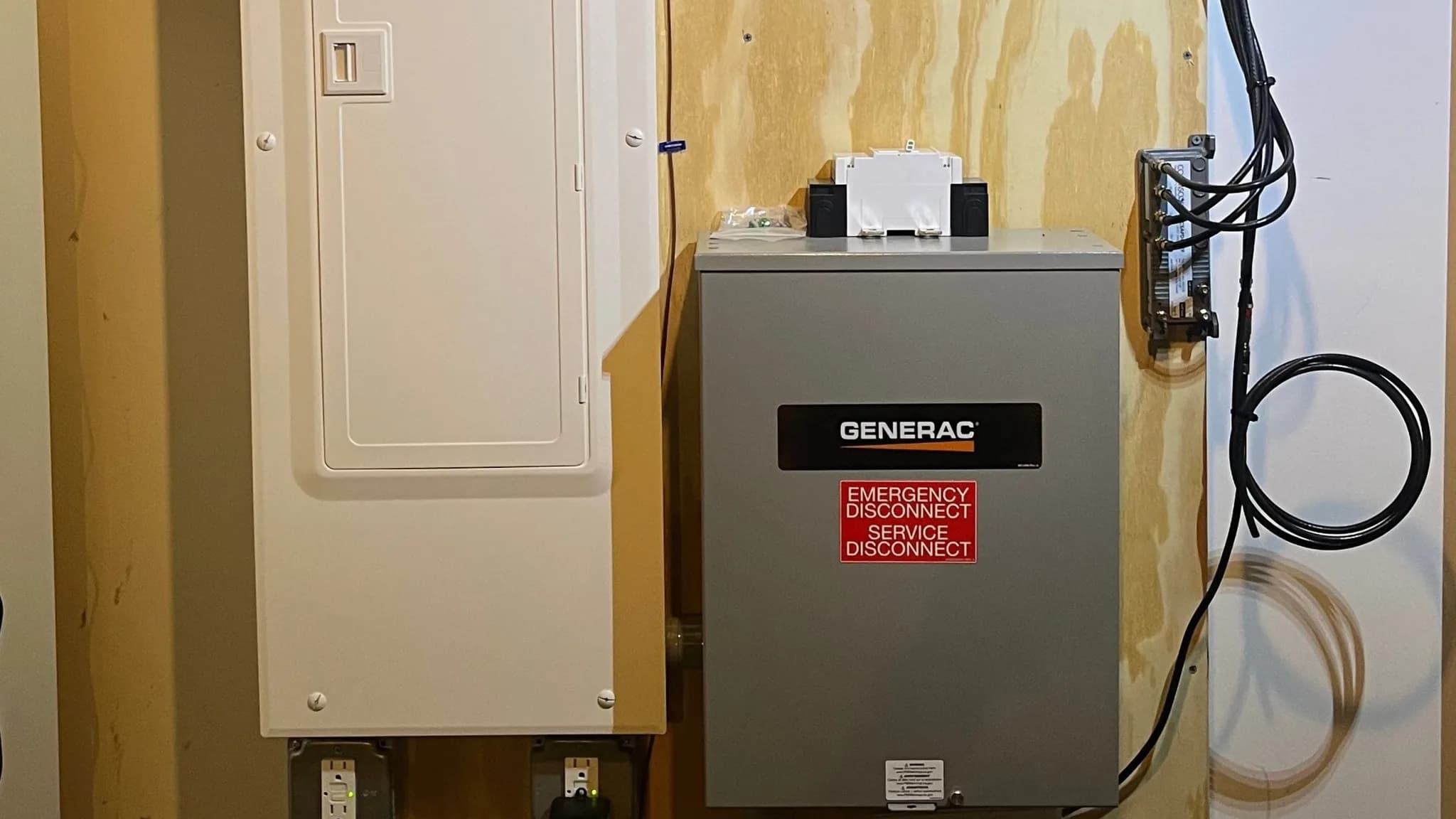
Because a correctly sized generator still has to start on its own and run for days. A permanently installed standby unit pairs with an automatic transfer switch that watches utility power around the clock, starts the generator when the grid fails, usually within seconds, and, as NEC Article 702 requires, keeps generator power from ever backfeeding onto the utility line, which protects the crews working to restore power. It also has to be fed, by natural gas or propane, at a delivery rate that carries the load, and a propane tank has to be big enough to run for the length of a real outage. That fuel hookup is made by your gas or propane supplier or a licensed gas fitter. We set the pad, make the electrical connection, install the transfer equipment, and handle the permit and inspection, and we coordinate the timing with whoever makes the fuel hookup, so the whole system works as one, not just the box on the pad.
Do I still need to worry about carbon monoxide with a standby unit?
A properly installed standby generator takes the daily carbon-monoxide risk out of your hands, and that is a real safety gain over a portable. The Consumer Product Safety Commission attributes an average of roughly 85 carbon-monoxide deaths a year in the United States to portable generators, which must be run outdoors at least 20 feet from the home every single time. A standby unit sits permanently in a safe, code-compliant location, sized and sited by a licensed electrician, and vents away from the house by design. That peace of mind is a big part of why people in the Merrimack Valley choose standby.
How do I decide which circuits to back up?
Start with the things that cause real damage or danger if they go down, then work outward. At the top of the list for a New Hampshire home are the heating system, the well pump, and the sump pump, because losing those in winter risks frozen pipes and a flooded basement. Next come the refrigerator and freezer, a few lighting and outlet circuits, and any medical equipment. After that are the comfort and convenience loads: the range, the dryer, central air, the hot tub. On an essential-circuits system, we help you draw that line so the generator covers what matters and the transfer switch or load manager handles the rest gracefully. On a whole-house system you skip the triage, because everything is carried, but the sizing has to be right for that to hold.
Does a bigger generator cost more to run?
It can, because a larger engine burns more fuel per hour, especially under heavy load, and that adds up over a multi-day outage on propane. That is another reason not to oversize out of caution: an oversized unit costs more to buy and more to feed, without giving you anything you use. It is also why load management is such a good tool, because it lets a right-sized unit cover a home efficiently instead of forcing you up to a thirstier generator. We factor running cost and fuel type into the recommendation, not just the purchase price, so the unit makes sense the day you buy it and every day it runs.
How do I get the right size for my home?
Start with a walk-through. We ask what you cannot do without in an outage, measure the real load, factor in your heat, water, and sump priorities, confirm you have a gas or propane supply that can serve the unit, and give you a written quote for a unit sized to your home. We handle the pad, the electrical connection, the transfer switch, and the permit and inspection as one job, and we coordinate with the fuel supplier or licensed gas fitter who makes the gas or propane hookup, so the generator you buy is the generator that actually carries your home the night the grid drops. Whether you are in Windham, Sandown, or across the state line in one of the Essex County towns we serve, Honesty and Quality above all else means we size for what you need, not for the biggest number on the invoice, and the estimate is free.
Have a question this did not cover? Call or text us at (603) 401-7359 and we will give you a straight answer.
Sources
- Generac - What Size Generator Do I Need? (sizing guide, load management)
- Generac - Find the Right Generator (home standby sizing tool)
- NFPA - Understanding the National Electrical Code (Article 702 optional standby, transfer equipment)
- U.S. CPSC - Portable Generator-Related Carbon Monoxide Deaths
- NH Division of Fire Safety - Fire Codes Adopted for NH (NEC 2023)
- U.S. Department of Energy (BSESC) - Home Electrification and Electric Panel Upgrades
- Consumer Reports - Portable vs. Standby Generator