
Last updated September 27, 2026
A standby generator starts itself and powers your home automatically through a transfer switch. A portable costs less up front, but you roll it out, connect it, and start it by hand every outage, and it has to run well away from the house because its exhaust is deadly. Which is right for you comes down to three honest questions: how much of the house you want to keep on, how hands-on you want to be when a storm hits at 2 a.m., and how you feel about the carbon-monoxide risk a portable carries. Lembo Electric installs and safely connects both across Rockingham County and the Merrimack Valley, and we will tell you which one actually fits your home. The estimate is free.
What does each option cost?
As general figures to set expectations, national cost guides put portable units in the range of about 500 to 1,500 dollars, while an installed standby system commonly starts around 5,000 dollars and climbs from there with the pad, the transfer equipment, the permit, and the inspection, plus the gas or propane hookup from your fuel supplier or a licensed gas fitter. The important thing to understand is that the generator is only one line item of a standby price, and the labor and materials around it are the rest. A portable's sticker looks cheaper because it does not include a safe way to connect it to your house, which is a real and necessary cost if you want it to power circuits rather than run extension cords. We give you a true quote for your home rather than a sticker number.
How different is the convenience, really?
Very. A standby unit with an automatic transfer switch watches utility power around the clock and restores your home on its own, usually within seconds, whether you are home, asleep, or away. A portable means going outside in the weather, connecting it, starting it, refueling it every several hours, and shutting it down and restarting it to refuel safely, for as long as the outage lasts. If you travel, if you are older, or if a dead sump pump or frozen pipes would be a disaster while you are gone, that difference is the whole decision. In a place where a February nor'easter can knock power out for days, hands-off matters.
What about carbon monoxide safety with a portable?
This is the part people underestimate, and it is the most important thing on this page. The U.S. Consumer Product Safety Commission attributes an average of roughly 85 deaths a year in the United States to carbon monoxide from portable generators. Carbon monoxide is invisible and odorless, and it kills fast in an enclosed space. A portable must run outdoors only, at least 20 feet from any window, door, or vent, with the exhaust pointed away from the home, every single time, and never in a garage or breezeway even with the door open. Many newer portables now include a CO shutoff sensor, which helps, but it does not replace safe placement. A properly installed standby unit sits permanently in a safe, code-compliant location and vents away from the house by design, which takes that daily judgment call out of your hands.
Can a portable safely power my house circuits?
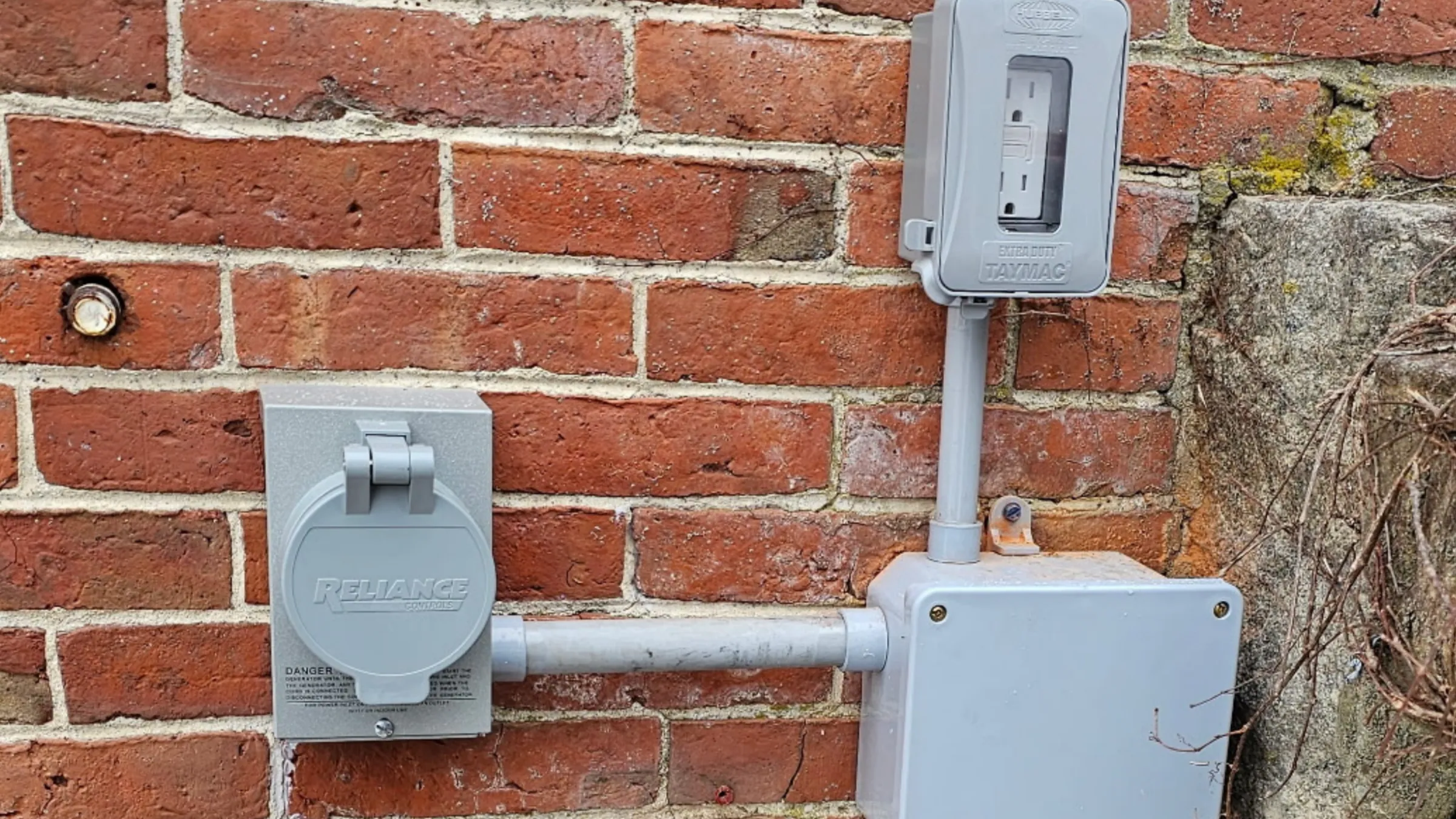
Not by running cords through a cracked window, but yes when it is connected correctly. The safe, code-compliant way to feed house circuits from a portable is through a transfer switch or an interlock, so the portable and the utility can never energize the wiring at the same time. That is not just good practice, it is what NEC Article 702 requires for any optional standby source, portable or permanent, and it is the same backfeed protection that keeps line crews safe. We install a manual transfer switch or a properly listed interlock and a dedicated inlet, so when the power goes out you plug in one cord, flip the switch, and safely run the heat, the well pump, the refrigerator, and a few key circuits. What we will not do is set up an unsafe backfeed, no matter who asks.
Which one is right for a New Hampshire home?
It depends on your home and how you live. A portable with a proper transfer switch is a sensible, budget-conscious choice for a homeowner who is around, does not mind the routine, and mainly wants to protect the essentials through the occasional outage. A standby unit makes more sense for a home on a well, a household that travels, anyone with medical equipment, or a family that simply does not want to think about it when a storm rolls through Salem, Plaistow, or across the line into Methuen. We size and price whichever one fits, and tell you honestly when the cheaper option genuinely covers what you need.
Do I need a permit either way?
For the wiring, yes. Installing a transfer switch or a generator inlet is permitted electrical work in both states. In New Hampshire it is done under the state-adopted 2023 National Electrical Code and inspected locally, and in Massachusetts towns like Haverhill and Andover it is done under 527 CMR 12.00 and filed with the local Inspector of Wires. We pull the permit under the correct state license, NH 13087 in New Hampshire and MA 20906-EL-A in Massachusetts, and get the work inspected so your backup setup is safe and on the record.
How much fuel does each one use in a long outage?
This is where the two really diverge over a multi-day storm. A portable runs on gasoline, which means storing fuel safely, refueling every several hours around the clock, and finding an open gas station when the whole town is dark. Gasoline also goes stale, so the cans in your garage may not start the unit next winter without fresh fuel and stabilizer. A permanently installed standby unit runs on your natural gas line, which never runs out, or on a propane tank sized to carry the outage, so it just runs. In a February ice storm that keeps Rockingham County dark for days, the difference between babysitting a gas can at 3 a.m. and a generator that quietly runs itself is the whole point.
Which one needs less maintenance and lasts longer?
A standby unit asks for scheduled service, an oil and filter change and a battery check on an interval, plus the weekly self-test it runs on its own, and in exchange it is built to run for days at a time and last many years. A portable is simpler but harder-used per outage, and it needs its fuel managed, its oil watched, and safe storage between storms. Neither is maintenance-free, but a standby unit is designed to sit ready and start on its own, while a portable depends on you keeping it and its fuel in shape. We will tell you honestly what upkeep each choice really involves so there are no surprises down the road.
Can I start with a portable and add a standby unit later?
Yes, and it is a reasonable way to phase the cost. Many homeowners start with a portable and a properly installed transfer switch or interlock to cover the essentials, then move up to a standby unit when the budget allows. The transfer-switch wiring you pay for with a portable is not wasted, because it is the same safe-connection principle a standby uses, though the standby will have its own automatic transfer equipment. If you think a standby is in your future, tell us now, and we can set up the portable connection in a way that makes the later upgrade cleaner.
How do I decide?
Have us look at your home and your priorities. We measure what you want to keep running, tell you what a portable would safely cover versus what a standby unit would carry, and give you a written estimate for each path so you can choose with real numbers instead of a guess. Our team does this for homeowners across Rockingham County, from Atkinson and Hampstead to Derry and Kingston, and down into the Merrimack Valley towns of Methuen and Haverhill, always with the correct state license on the permit, NH 13087 in New Hampshire and MA 20906-EL-A in Massachusetts. Honesty and Quality above all else means the recommendation fits your home, not the biggest invoice, and the estimate is free either way.
Have a question this did not cover? Call or text us at (603) 401-7359 and we will give you a straight answer.
Sources
- U.S. CPSC - Portable Generator-Related Carbon Monoxide Deaths
- Generac - What Size Generator Do I Need? (standby, automatic transfer switch)
- NFPA - Understanding the National Electrical Code (Article 702 optional standby, transfer equipment)
- Consumer Reports - Portable vs. Standby Generator
- NH Division of Fire Safety - Fire Codes Adopted for NH (NEC 2023)
- Mass.gov - 527 CMR 12.00 Massachusetts Electrical Code (amendments)